How to Build AI Landing Pages That Convert: Landingi + AdCreative Workflow
AI can generate landing-page copy and ad designs quickly, but conversion depends on whether the page matches the visitor's intent. A high-performing funnel connects one audience, one promise, one proof set, and one action. More content is not automatically better.
This workflow uses Landingi for the page and testing, and AdCreative for ad concepts that carry the same promise into the page.
Start with a one-page strategy brief
- Audience: Define a specific person and situation.
- Problem: Describe the costly or frustrating issue they want solved.
- Offer: State what they receive and how it helps.
- Proof: Gather testimonials, demonstrations, results, or credentials.
- Action: Choose one primary conversion: buy, book, register, or request information.
Do not ask AI to invent testimonials, client logos, or results. Use only claims you can support.
A landing page structure that works
- Hero: Clear outcome, supporting sentence, primary CTA.
- Problem: Show that you understand the visitor's situation.
- Solution: Explain the mechanism, not just the features.
- Benefits: Translate capabilities into outcomes.
- Proof: Add real evidence close to the decision.
- Objections: Answer price, time, fit, and risk questions.
- Final CTA: Repeat the next step with no ambiguity.
Build the page in Landingi
Landingi combines a drag-and-drop page builder with templates, AI assistance, A/B testing, and lead-generation features. Use AI to draft sections, then edit for specificity.
A practical prompt is: “Write three hero sections for [audience] who struggle with [problem]. The offer is [offer]. Emphasize [differentiator]. Use a concrete headline under 12 words, one supporting sentence, and a CTA beginning with an action verb. Do not invent statistics.”
Create matching ads with AdCreative
AdCreative can generate platform-specific ad variations and help teams produce more creative concepts. The important rule is message match: the ad and landing page should make the same core promise.
- Use the same audience language in the ad and hero.
- Send each ad to the most relevant page, not a generic homepage.
- Test one meaningful variable at a time: hook, visual, proof, or offer.
- Do not treat an AI performance score as guaranteed campaign performance.
Measure the whole funnel
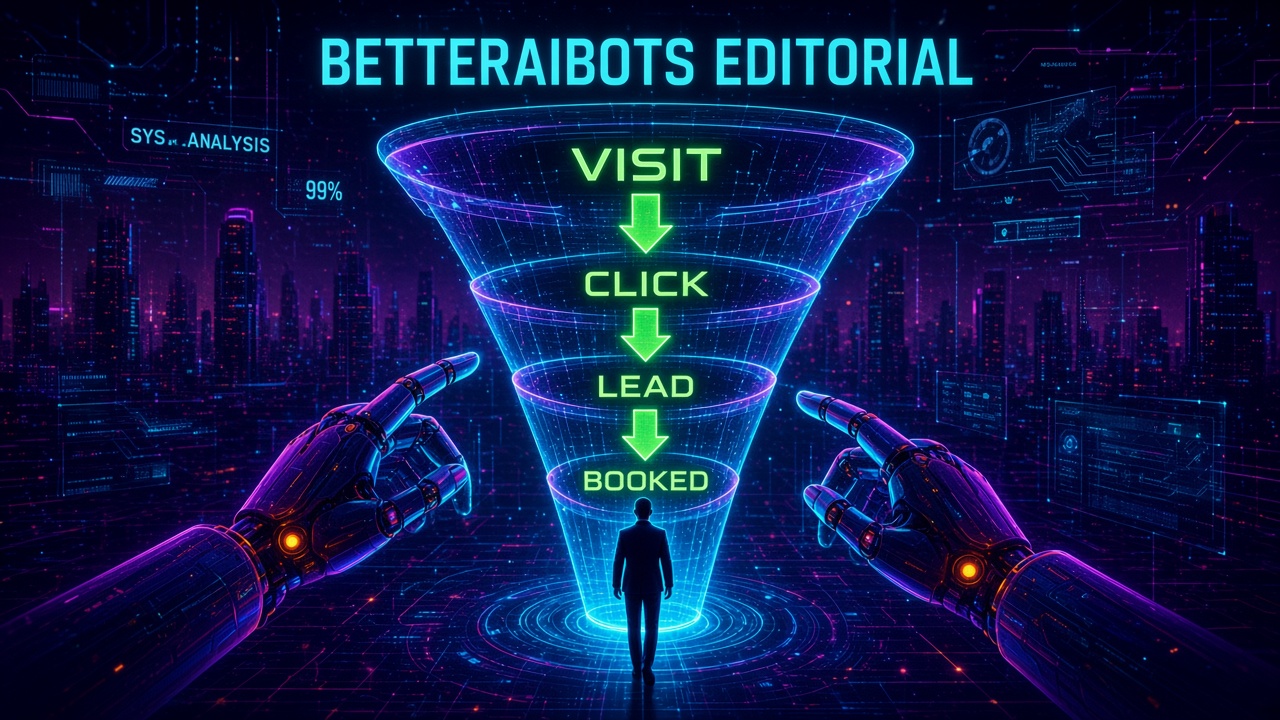
Track metrics in sequence instead of celebrating clicks alone:
- Ad click-through rate: Is the hook relevant enough to earn attention?
- Landing-page conversion rate: Does the page continue the promise clearly?
- Lead quality: Are the right people completing the action?
- Sales conversion: Do leads turn into meaningful revenue?
- Cost per result: Is the complete funnel economically sustainable?
Three useful A/B tests
- Outcome headline vs pain headline: Test aspiration against problem awareness.
- Demo vs testimonial: Test showing the product against customer proof.
- Direct CTA vs low-friction CTA: Compare “Book a Demo” with “See How It Works.”
Run tests long enough to collect meaningful data. Do not declare a winner after a handful of visits.
Build your first funnel
Read the AdCreative guide and browse the free-trial tools directory. Landingi's retired Learn URL currently redirects to the active Apps directory, so use its current listing there for the latest access path. Track both tools in My AI while you compare results.